Improving services
Local government services are under increasing strain. Demand continues to rise far more quickly than available resources, particularly in high-cost areas such as Children’s and Adult Social Care, Special Education Needs and Disabilities (SEND) and Home to School Transport, creating unsustainable financial pressures.
Communities across Warwickshire have diverse and evolving needs, meaning that the challenges they face across the full range of life outcomes differ across the county. This requires flexible, targeted and responsive services which are tailored to the places and the people we serve.
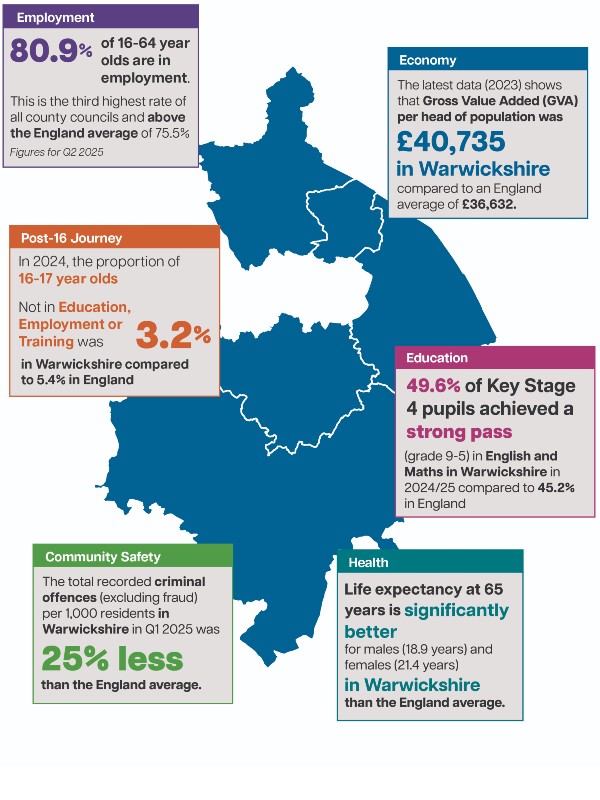
The diagram highlights some of these areas and Our State of Warwickshire report 2025 provides further insight and detail on this.
Employment
80.9% of 16 to 64-year-olds are in employment. This is the third highest rate of all county councils and above the England average of 75.5%. Figures for Quarter 2 2025.
Economy
The latest data (2023) shows that Gross Value Added (GVA) per head of population was £40,735 in Warwickshire compared to an England average of £36,632.
Post-16 journey
In 2024, the proportion of 16 to 17 year olds not in education, employment and training was 3.2% in Warwickshire compared to 5.4% in England.
Education
49.6% of Key Stage 4 pupils achieved a strong pass (grade 9 to 5) in English and Maths in Warwickshire in 2024/25 compared to 45.2% in England.
Community safety
The total recorded criminal offences (excluding fraud) per 1,000 residents in Warwickshire in Quarter 1 2025 was 25% less than the England average.
Health
Life expectancy at 65 years is significantly better for males (18.9 years) and females (21.4 years) in Warwickshire than the England average.
Despite the long-term nature of these challenges, there is an opportunity to act and make a difference now, improving services and value for money, focusing on our priority outcomes while stopping unnecessary activity, and ensuring we are in the best possible position for future change.
Building a new, better local government structure for Warwickshire
The Government is driving Local Government Reorganisation (LGR) across all remaining two-tier areas (areas with both county and district/borough councils), which is likely to create one or two new unitary councils in Warwickshire by April 2028. This is a reality and represents the most significant change for local government in a generation.
This Plan recognises that LGR will be a key priority over the next two years and beyond. As Warwickshire’s councils navigate this complex transition and embed the new arrangements service continuity for residents and stability for staff will be essential.
We are clear that the new structure will combine the best of the county, district and borough councils’ services and capabilities, building on our existing strong relationships. We will work constructively and enthusiastically to build this new local government structure for Warwickshire, and make sure it delivers better services and improves longer-term outcomes for people.
Transforming for the future
Warwickshire has a strong record of ambitious reform focused on early intervention, prevention and integration. As a national pathfinder for Families First for Children, the council is reshaping children’s social care, in addition to improving SEND provision, strengthening education and skills, and working with partners to deliver integrated, community-based approaches that support resilient communities and sustainable economic growth.
Rising demand, limited resources and growing complexity mean public services must evolve to be fit for the future. We will focus on early help, prevention, family and community resilience, better use of technology and stronger partnerships, so that problems are dealt with sooner, services are easier to access and taxpayers’ money goes further.