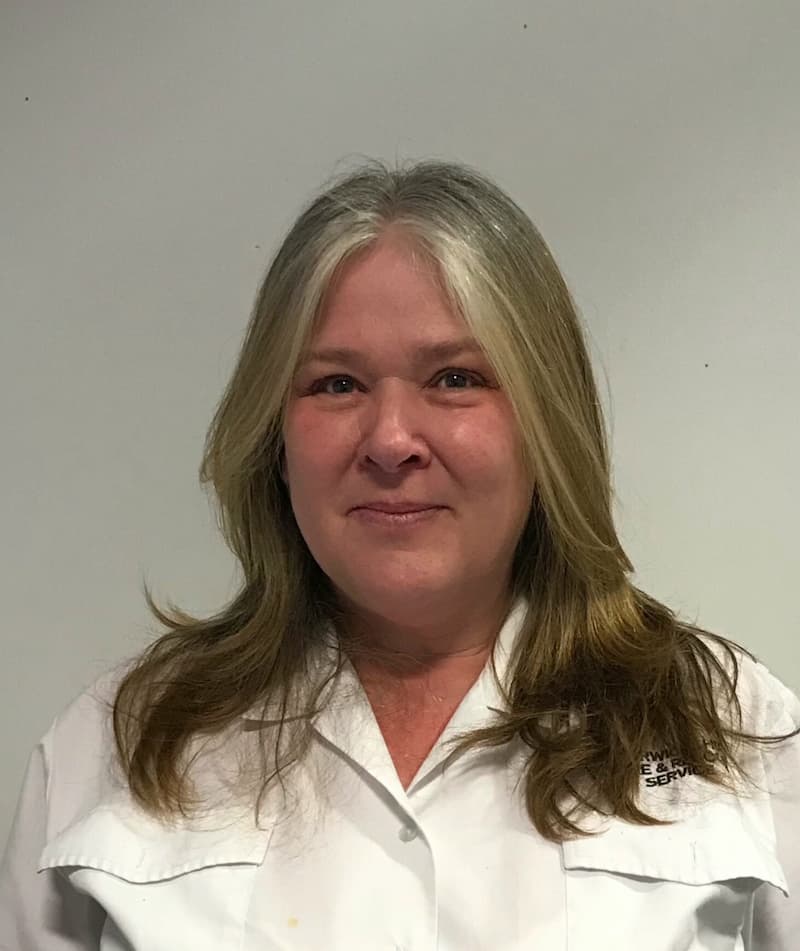
From handwritten incident logs and card filing systems to computerised mobilising and mobile phones, Debbie Gaskins has witnessed almost every major change in Fire Control over the past four decades.
As she enters her 45th year with Warwickshire Fire and Rescue Service, Debbie reflects on the incidents that have stayed with her, the colleagues who became lifelong friends, and how a job she thought would be temporary became the career she was always meant to have.
At 18, having just qualified in Hotel Management, I was thinking about where I wanted to travel and work. A friend mentioned a vacancy in Fire Control. The role involved shift work, including weekends and nights, and she thought it would suit me. Obviously, she didn't fancy it herself at the time as she had a busy social life!
Knowing nothing about the Fire Service and very little about what Fire Control actually did, I decided it seemed like an excellent idea until I worked out what I really wanted to do with my life.
I was told that more than 300 people had applied and attended the first stage of the recruitment process. This involved a listening and transcription exercise to test spelling, accuracy and the ability to record information correctly. I remember sitting alongside candidates discussing their computer and software qualifications. I thought I didn't stand a chance.
Somehow, I made it through to the next round, which was a formal interview panel consisting of two officers and the Personnel Manager. I left convinced I should start applying for other jobs.
Four weeks later, Dennis Lawrence, the Personnel Manager, knocked on my front door. When I answered, he told me I had been successful and asked when I would like to start. So, on 13 September 1982, I joined the Fire Service with no experience and absolutely no idea what I would be doing.
And that is where it all began.
The Control Room was daunting. The Senior Control Operator sat on an elevated platform at the back of the room, overseeing the semi-circular work area where the Operators, as we were known then, sat and worked. Above us were the fire alarm connections from premises whose alarms came directly through to Control.
It was a very strict environment. We stood when officers entered the room, saluted them, and addressed them as "Sir". At that time, the only women in uniform were those working in Control.
Everything was done manually. Incoming calls were written on printed incident log sheets. Every action involved checking the clock and handwriting messages. Appliance attendances were recorded on a card filing system. Supervisors would stand up, pull out long trays of cards from their desks, search through them and check attendance information and supporting actions. At midnight, the Supervisor would sort and number all the incident sheets ready for filing.
Mobilising fire stations was a process in itself. Buttons were pressed, levers operated and messages spoken directly to wholetime stations through the communications equipment. Announcements went out over the tannoy, detailing appliances required, incident type and address. If there was too much information to pass before the system timed out, crews sometimes received only part of the details. Day-crewed and retained stations would contact us for further information, which we would pass via telephone or appliance radio.
At that time, we were responsible for 20 fire stations. Our resources included 28 pumping appliances, three hydraulic platforms, three emergency tenders, a foam tanker, a CO₂ unit and a Control Unit. The specialist appliances were crewed as primary resources. With those assets available, the county could deal with almost anything. Requesting support from neighbouring brigades was rare.
Control staff also crewed the Control Unit. I attended many incidents, providing fireground communications support and maintaining links back to Fire Control.
Around 1984-85, we received our first computerised mobilising system. Alongside it came what felt like a very futuristic piece of equipment: a suitcase-sized mobile phone. The new technology was installed into specially designed workstations and transformed the Control Room.
We said goodbye to card files, mountains of paperwork and boxes full of pens. We even had what felt like a "James Bond" mobilising suitcase that allowed stations to be mobilised from anywhere with a telephone connection should we ever need to leave the Control Room.
As my career progressed, I was promoted first to Leading Fire Control Operator and then to Senior Control Operator. Being called "Ma'am" by firefighters felt very strange at first.
Each promotion required attendance on a three-week course at the Fire Service College in Moreton-in-Marsh. These courses were fascinating because they brought together colleagues from across the country. They provided valuable insight into how larger brigade control rooms operated and offered opportunities to share experiences and ideas.
Technology continued to evolve over the years. Computer systems were upgraded, radio equipment improved and new tools such as pagers and mobile phones became part of everyday life. Despite these changes, the core purpose of the job remained the same.
The county itself has also changed significantly. Fire station locations, operational resources and the communities they serve have evolved over the decades, with new housing developments continuing to emerge across Warwickshire. Looking back, it's remarkable how the Service has adapted to meet new and emerging risks, despite operating in a very different landscape to that of the 1980s, 1990s and 2000s.
Throughout the years, Control has taken on many different responsibilities, including monitoring fire alarms, pendant alarms, social services calls and foster care calls. Yet the heart of the role has never changed.
There are many incidents that remain with me. Some were tragic, some unusual, and some brought moments of great pride. Along the way, we have also lost valued colleagues. Every incident leaves its mark. The losses affect us deeply, but so do the successes. We always play a part in saving lives, and thankfully we save many more than we lose.
Now, as I enter my 45th year with the Fire Service, I can honestly say I never imagined staying this long. What began as a temporary job while I decided what direction to take in life turned out to be my career.
It seems Fire Control was the answer all along.
I am proud of the career I have chosen, the people I have worked alongside and the many colleagues I have trained and supported over the years. They are no longer simply work colleagues; they are friends.
For me, a day at work is a day spent with people I care about, doing a valuable job and helping to look after our county.