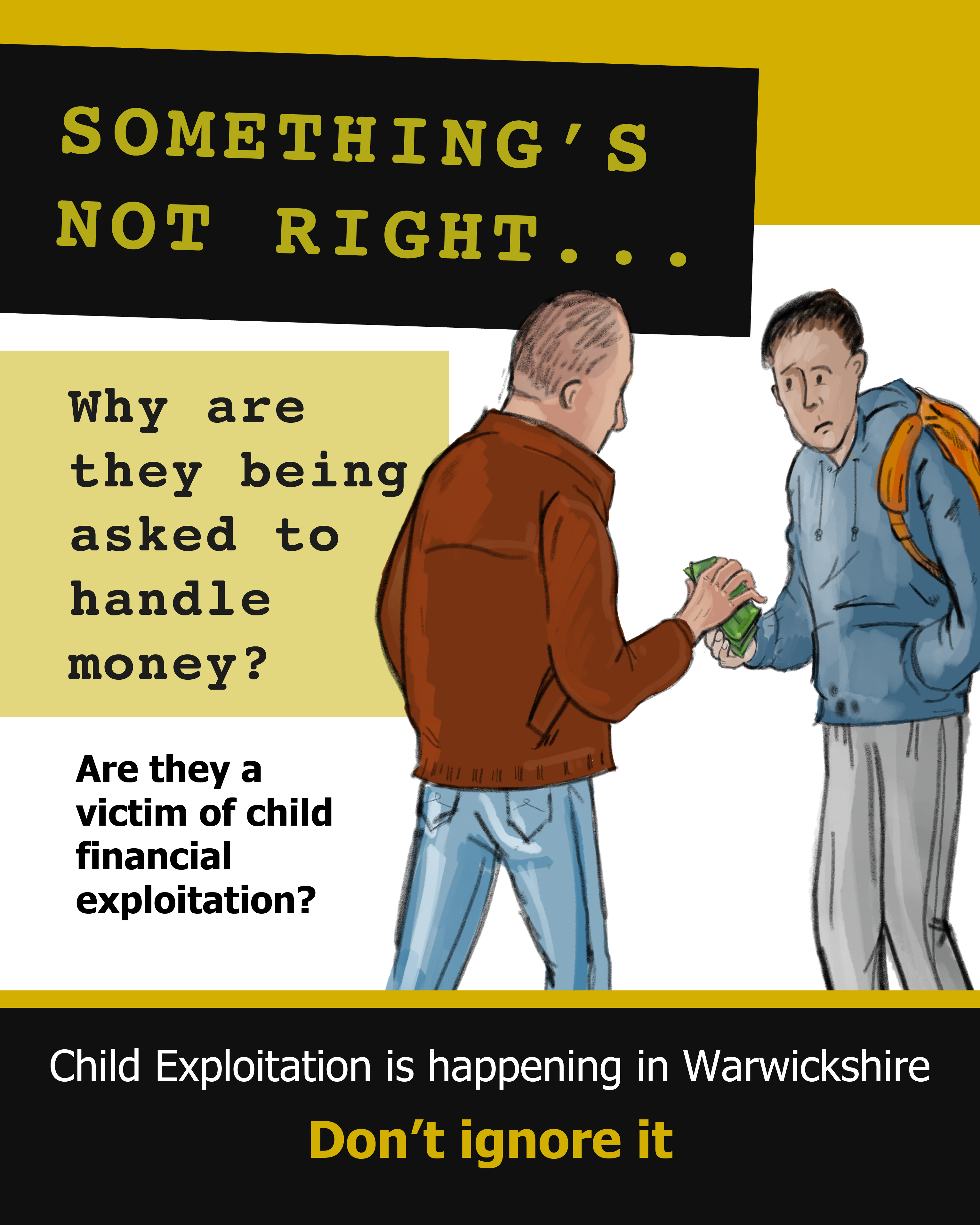
Warwickshire agencies are once again joining the national effort to tackle child exploitation as part of Child Exploitation Awareness Day on Wednesday 18 March.
Partner organisations – including Warwickshire County Council (WCC), Warwickshire Police, Barnardo’s, the Warwickshire NHS Integrated Care Board (ICB), the Warwickshire Safeguarding Partnership Board, and the Office of the Police and Crime Commissioner (OPCC) – will be working together throughout the week to raise awareness through a series of online and in‑person activities.
Every year, hundreds of children and young people experience exploitation. Behaviours such as missing school, secrecy online, or spending time with older individuals can all be signs that something isn’t right – and everyone has a part to play in spotting and reporting concerns.
This year’s campaign in Warwickshire highlights several forms of exploitation, including:
- Child financial exploitation – when individuals or groups use power, control or manipulation to coerce a child into financial activity for someone else’s gain.
- Acquisitive child criminal exploitation – where children are pressured or forced into committing crimes for financial benefit.
- Online child exploitation, including awareness of “The Com”, a fast‑growing online network that targets vulnerable children.
- Child sexual exploitation (CSE) – when someone takes advantage of a child or young person sexually.
- Vaping used as a grooming tool, with criminals offering vapes to manipulate or coerce young people.
Throughout the week commencing 16 March, agencies across Warwickshire will be engaging with local communities, young people, and professionals to increase understanding of how exploitation happens – both online and offline.
Residents are being encouraged to make a pledge to help stop child exploitation by learning the signs and reporting concerns if something feels wrong.
Schools and youth groups will be supported to educate young people, staff and volunteers about issues such as peer-to‑peer exploitation, online risks, warning signs including persistent absence from school, and the impact exploitation can have on mental health.
Professionals working with children and young people can access free online training throughout the week. The full schedule and booking information can be found at:
https://www.safeguardingwarwickshire.co.uk/wp-content/uploads/2026/02/CE-Week-2026-Online-training-schedule-FINAL.pdf
How everyone can get involved
- Learn the signs of child exploitation
- Know how and where to report concerns
- Share a message of support on your hand and post it on social media with #CEADay26 #HelpingHands #WarwickshireCE
- Amplify messages shared by WCC and partner organisations on social media
Potential warning signs
Children and young people experiencing exploitation may show behaviours such as receiving unexpected gifts or money, associating with older individuals, using drugs or alcohol, mood swings, self‑harm, going missing, staying out late, secrecy, or skipping school.
Warwickshire remains committed to creating safe environments where young people feel protected from harm and supported to speak out.
Where to get help
- Visit www.somethingsnotright.co.uk for information on spotting the signs and seeking advice.
- If you’re worried about a child or young person, contact Family Connect (Monday–Friday, 9am–5pm) on 01926 414144.
- Report concerns to Warwickshire Police via their website or by calling 101 or contact your local Children and Family Centre.
- Contact Crimestoppers anonymously on 0800 555 111.
- Speak to a trained counsellor at any time via ChildLine on 0800 11 11 or the NSPCC on 0808 800 5000.
- If someone is in immediate danger, call 999.
Child exploitation can affect any child, in any community. Warwickshire agencies are calling on everyone to recognise the signs, speak up, and help ensure there is zero tolerance for all forms of exploitation.
Councillor George Finch, Leader of Warwickshire County Council and Portfolio Holder for Children and Families said:
“I urge everyone in Warwickshire to support Child Exploitation Awareness Week and learn the signs of exploitation by following the week’s awareness activities. Greater understanding is key to ending the exploitation of children and young people, online and offline.
“Every one of us has a role in safeguarding. Spot the signs, speak up, and help children and young people live safe and healthy lives.”
Warwickshire County Councillor Dale Bridgewater, Portfolio Holder for Community Safety and Chair of the Safer Warwickshire Partnership Board, said:
“Child exploitation affects not just the young people targeted, but communities across Warwickshire. This campaign shows how closely linked exploitation is with issues like knife crime, fraud, theft and other criminal activity.
“Please learn the signs and report anything that doesn’t feel right. Together we can help keep children, young people and our communities safe.”
Detective Supt Charlie Naughton, Head of Public Protection, Warwickshire Police said:
“Child exploitation is happening in Warwickshire, and it can happen to any child. During Child Exploitation Awareness Week, we are urging people to look out for the signs of exploitation and report their concerns to police.
“The information you provide could help us safeguard a vulnerable child and bring a dangerous offender to justice.”
Warwickshire Police and Crime Commissioner Philip Seccombe said:
“As Police and Crime Commissioner I am committed to ensuring that young people in Warwickshire are protected from exploitation and supported to speak out. Exploitation can be subtle, and it can occur anywhere, which makes public understanding so important.
“The services I commission, including Warwickshire BASE run by Barnardo’s and the West Midlands Anti-Slavery Network, play a crucial role in supporting young people, helping families and delivering high-quality training to those working with children. Their expertise strengthens our collective response and ensures support is available when it is most needed.
“This campaign is an opportunity for every resident to learn the signs, share the messages and play a part in protecting children. If something feels wrong, report it. Together we can help prevent exploitation and keep young people safe.”