County highways performance dashboard
Annual road condition scores
We undertake annual condition surveys of our classified road network (A, B and C Roads) which produce condition scores for our network. These scores are reported back to central government – more information can be found on GOV.UK.
We utilise these condition scores to help identify sections of our network requiring works. The graph shows our classified network condition scores:
- Red – Plan maintenance soon
- Amber – Plan investigation soon
- Green – Generally good condition
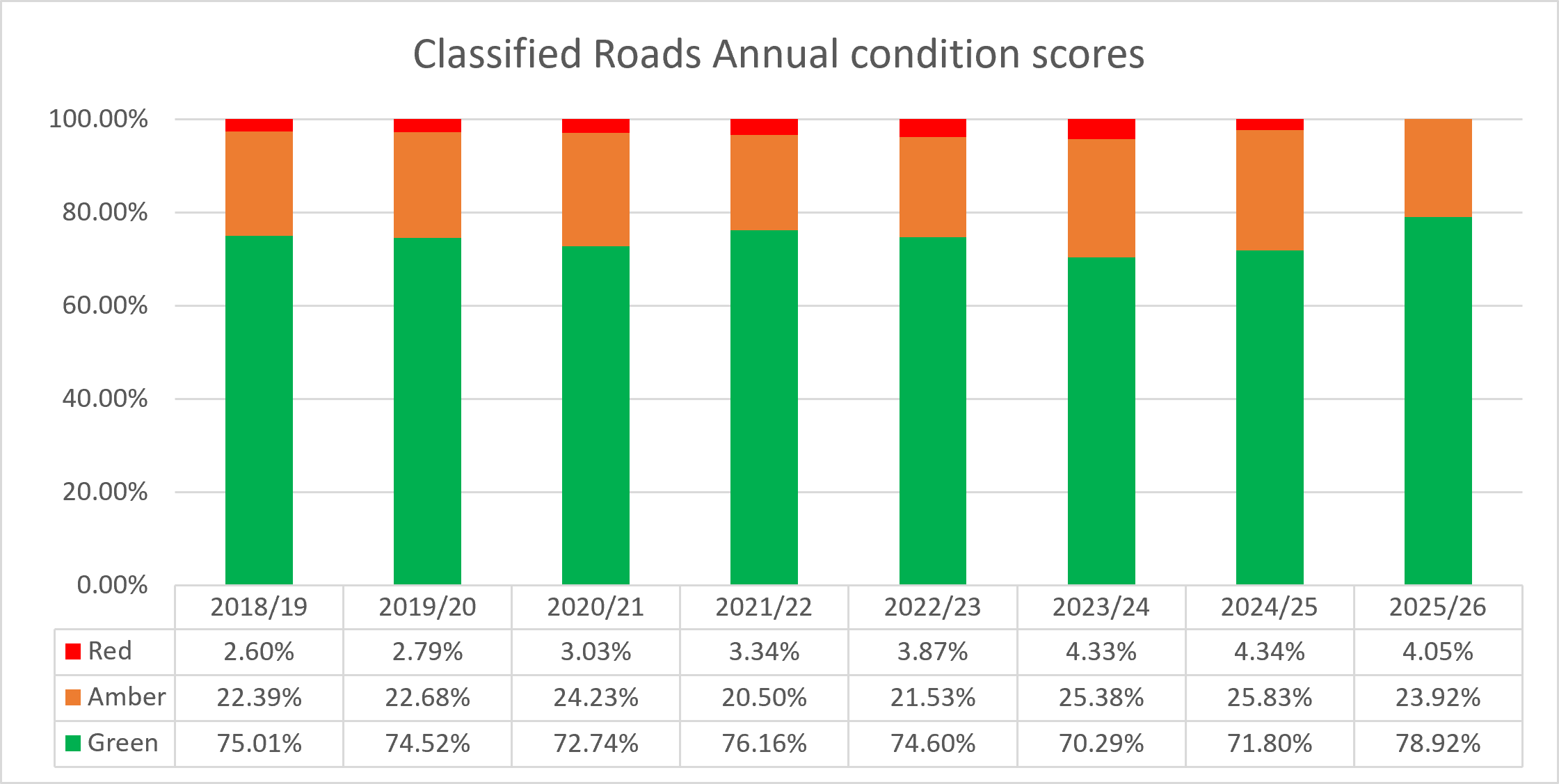
| Year | Green | Amber | Red |
|---|---|---|---|
| 2018/19 | 75.01% | 22.39% | 2.6% |
| 2019/20 | 74.52% | 22.68% | 2.79% |
| 2020/21 | 72.74% | 24.23% | 3.03% |
| 2021/22 | 76.16% | 20.5% | 3.34% |
| 2022/23 | 74.6% | 21.53% | 3.87% |
| 2023/24 | 70.29% | 25.38% | 4.33% |
| 2024/25 | 71.8% | 25.83% | 4.34% |
| 2025/26 | 78.92% | 23.92% | 4.05% |
Annual public satisfaction survey results
The National Highways and Transport (NHT) Survey is the only nationally benchmarked survey that measures residents satisfaction with local highways and transport services. Conducted independently the survey is sent to a random sample of households to provide an impartial and representative view of public opinion. The survey provides valuable insight into how residents perceive the condition of roads, the quality of maintenance, communication, and the overall service they receive. It complements technical performance data by helping authorities understand the experiences and priorities of the people who use the network every day.
The NHT survey covers a wide range of highways and transport services. For the purposes of this performance report, we have highlighted a number of key measures that provide a useful overview of residents views on the services most closely linked to the highway network. These results help us track performance over time, compare ourselves with other authorities, and identify opportunities to improve the services that matter most to residents.
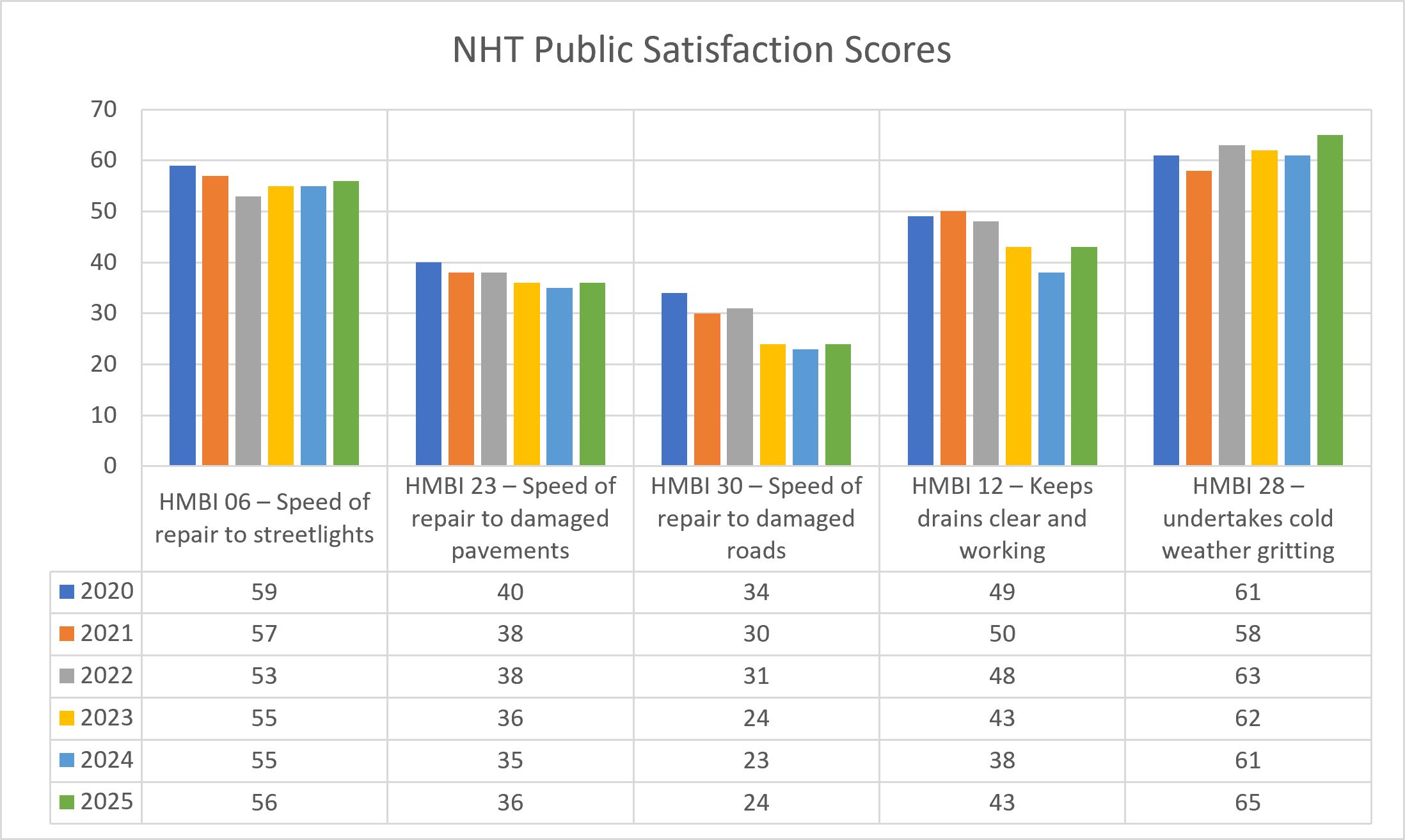
| Year | HMBI 06 - Speed of repair to street lights | HMBI 07 - Speed of repair to damaged roads/pavements | HMBI 08 - Quality of repair to damaged roads/pavements | HMBI 12 - Keeping drains clear and working | HMBI 17 - Undertakes cold weather gritting |
|---|---|---|---|---|---|
| 2020 | 59 | 40 | 34 | 49 | 61 |
| 2021 | 57 | 38 | 30 | 50 | 58 |
| 2022 | 53 | 38 | 31 | 48 | 63 |
| 2023 | 55 | 36 | 24 | 43 | 62 |
| 2024 | 55 | 35 | 23 | 38 | 61 |
| 2025 | 56 | 36 | 24 | 43 | 65 |
Annual potholes reported/repaired
This information shows the number of potholes reported to us by members of the public and the number repaired by our contractors each year. Repairs include temporary repairs, used to make a pothole safe in an emergency where needed, and permanent first-time repairs designed to provide a long-lasting repair.
Temporary repairs help us keep the highway safe, particularly where a defect needs prompt attention. Where appropriate, these locations may then be included in a planned programme for permanent repair, helping to provide a more durable solution.
We also have dedicated Find and Fix teams working across Warwickshire to repair smaller potholes and surface defects before they become more serious. This proactive approach helps keep roads safer, reduces future disruption, supports better value for money and improves the experience for road users.
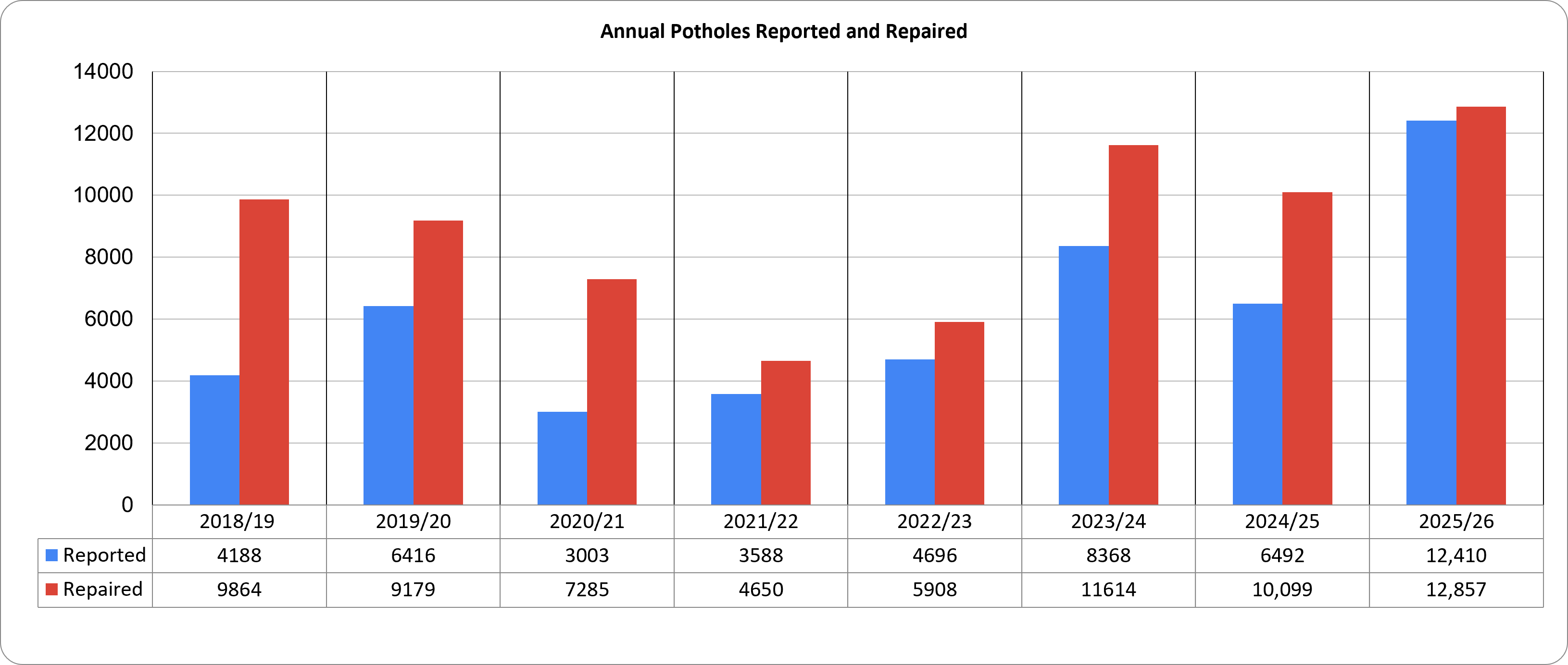
| Annual pothole quantities | Reported | Repaired |
|---|---|---|
| 2018/19 | 4188 | 9864 |
| 2019/20 | 6416 | 9179 |
| 2020/21 | 3003 | 7285 |
| 2021/22 | 3588 | 4650 |
| 2022/23 | 4696 | 5908 |
| 2023/24 | 8368 | 11,614 |
| 2024/25 | 6492 | 10,099 |
| 2025/26 | 12,410 | 12,857 |
Drainage – number of gullies inspected and cleaned per year
Warwickshire maintains more than 115,000 highway gullies across the county. To help reduce the risk of surface water flooding, all gullies are scheduled to be emptied at least once every two years. Since 2021/22, County Highways has used a variable-frequency cleansing approach, which means gullies are cleaned more often where there is a higher risk of flooding or where drainage systems are known to be more problematic.
Higher-risk locations may be cleansed every three or six months, depending on local conditions and known issues. Occasionally, a gully may not be cleaned during its scheduled visit because access is blocked, for example by parked vehicles or other obstructions. Where this happens, the gully is recorded and picked up outside the normal routine cycle so it can be cleansed when access is available.
| Gullies inspected and cleaned | Cleans per annum | Target | Percentage |
|---|---|---|---|
| 2022/23 | 74,554 | 77,575 | 96.11% |
| 2023/24 | 73,448 | 77,439 | 94.85% |
| 2024/25 | 76,088 | 77,400 | 98.30% |
| 2025/26 | 66,754 | 66,382 | 100.56% |
Street lighting – number of faulty lights reported to our contractors each year
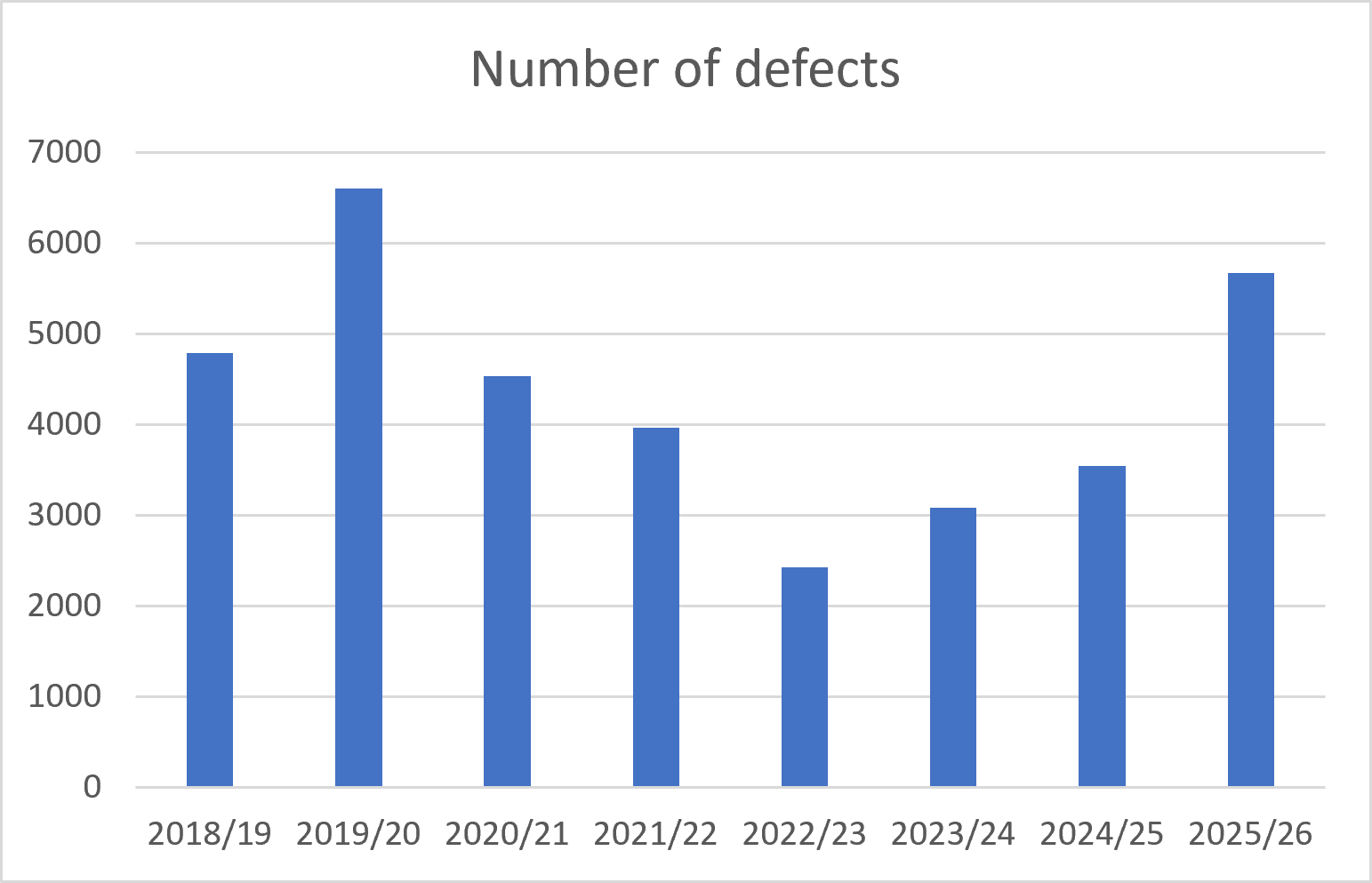
| Year | Number of defects |
|---|---|
| 2018/19 | 4784 |
| 2019/20 | 6598 |
| 2020/21 | 4534 |
| 2021/22 | 3966 |
| 2022/23 | 2418 |
| 2023/24 | 3081 |
| 2024/25 | 3540 |
| 2025/26 | 5673 |
Winter maintenance
We treat approximately 46%, 1,100 miles, of our network when we grit. We have a policy which states that when the formation of ice is predicted we will treat:
- all main traffic routes, A roads, most B roads and one or two other strategic routes
- in urban areas, the access to hospitals and main industrial estates
- a single route into villages
The details in the chart show the distance we travel and the amount of salt used each winter.
View more information on gritting
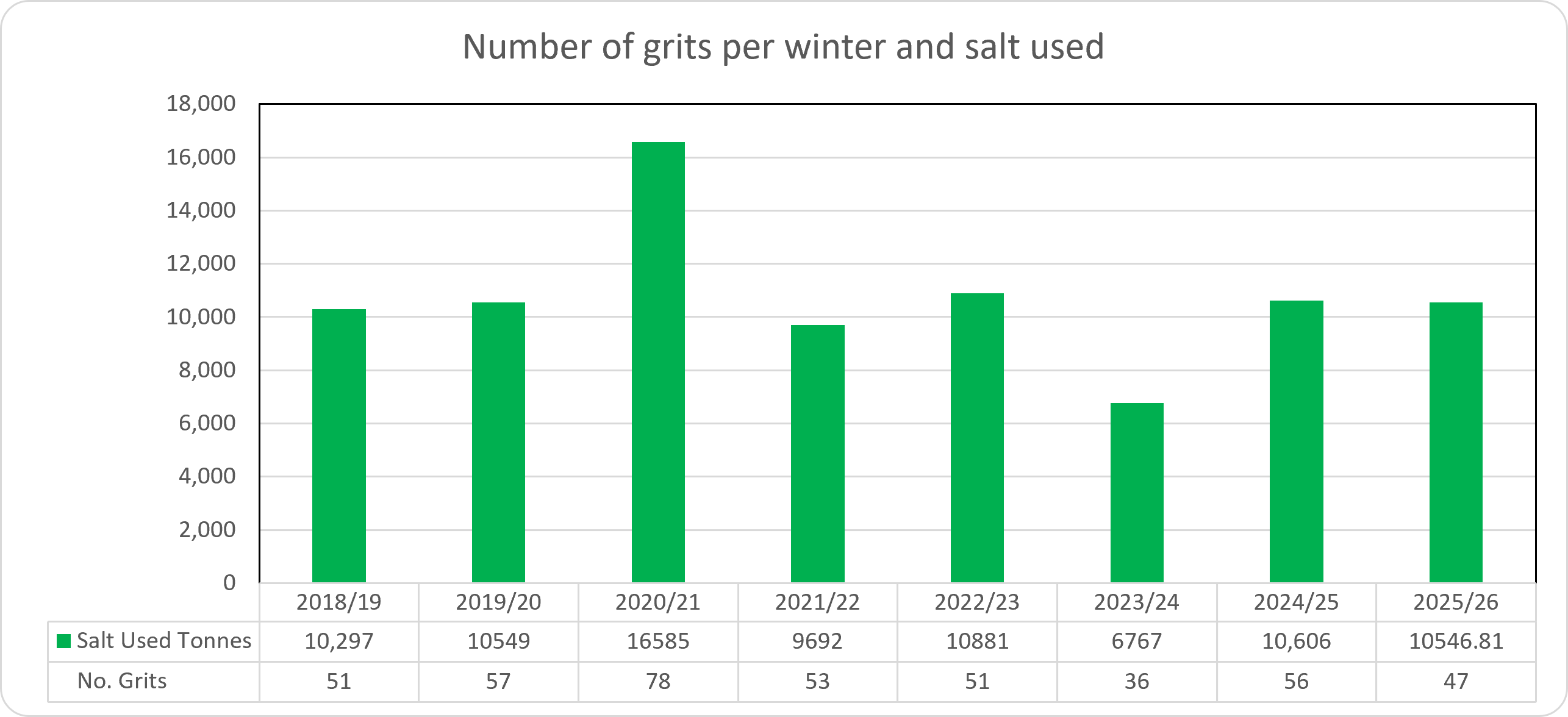
| Winter | Number of grits | Total miles | Times around UK coastline | Salt used - tonnes |
|---|---|---|---|---|
| 2018/19 | 51 | 57,209 | 7.36 | 10,297 |
| 2019/20 | 57 | 64,172 | 8.26 | 10,549 |
| 2020/21 | 78 | 87,692 | 11.29 | 16,585 |
| 2021/22 | 53 | 61,514 | 7.92 | 9692 |
| 2022/23 | 51 | 59,075 | 7.6 | 10,881 |
| 2023/24 | 36 | 41,721 | 5.37 | 6767 |
| 2024/25 | 56 | 64,606 | 8.32 | 10,606 |
| 2025/26 | 47 | 54,223 | 6.98 | 10,547 |